

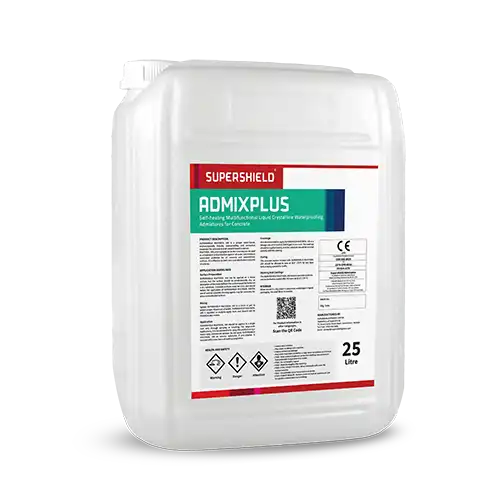
Supershield ADMIXPLUS
Self-healing Adaptive Liquid Crystalline Waterproofing Admixture for Concrete
ADMIXPLUS is a high-performance liquid crystalline waterproofing admixture powered by Adaptive Crystalline Technology®, designed to enhance concrete durability from the casting stage throughout its service life. When incorporated into the concrete mix, ADMIXPLUS supports sustained crystalline activation and proprietary ThermoHydric® regulation within the concrete matrix, promoting controlled hydration and stabilizing internal transitions during early concrete development and throughout its lifecycle. As the concrete matures, ADMIXPLUS contributes to the progressive refinement of pores and capillaries, improving the density of the internal structure, limiting permeability pathways, and supporting self-healing of microcracks. Throughout the service life of the structure, ADMIXPLUS helps maintain durability, structural stability, and long-term resilience in demanding infrastructure environments across both cold and hot climates.
Applications
Basements, Concrete Water Tanks, Tunnels and Subway Systems, Roof Slab, Sewage and Water Treatment Plants, Reservoirs, Sunken Portion, Foundations & Elevator pits, Ground parking structures, Bridges and dams
Features & Benefits
Advanced Admixture Technology

Liquid Crystalline Admixture
Compatible with Modern Concrete Formulations
VOC-Free Water-Based Formulation
Enhances Fresh and Hardened Concrete Performance
Hydration & Microstructure Engineering
Hydration & Moisture Regulation
Microstructural Densification
Concrete Matrix Stability with reduced free lime–related durability risks, including alkali–silica reaction (ASR)
ThermoHydric® Stability, Structural Longevity & Durability
ThermoHydric & Hygrothermal Stability under Evolving Environmental Conditions
Freeze–Thaw Resistance
Carbonation Resistance
Resistance to Chemical Attack Including Chlorides and Sulfates
(Longevity is achieved by stabilizing internal transitions within the concrete matrix, allowing the structure to withstand environmental exposure over time.)
Waterproofing and Crack Control
Permanent Internal Waterproofing through Crystalline Sealing of Pores and Capillaries
Self-Healing Micro-Crack Capability up to 0.5mm